- Enterprise Architecture: The Struggle is Real
- Posts
- Future-Proofing Fallacies: Why Predicting Technology Trends Is Hilariously Hard
Future-Proofing Fallacies: Why Predicting Technology Trends Is Hilariously Hard

Ralph Webster
November 28, 2025
Greetings, time-traveling architects!
Welcome back to another episode of Enterprise Architecture: The Struggle is Real — where we bravely attempt to see the future using nothing but trend reports, gut feelings, and that one consultant who insists blockchain will fix HR.
The Main Story: The Futurist Who Cried “Revolution!”
Picture this: It’s the annual strategy summit.
The CIO strides in wearing the expression of someone who just binge-watched five futurist TED Talks.
“Team,” she declares, “we must prepare for quantum-enabled, AI-infused, decentralized omniplatform convergence!”
Meanwhile, you’re still trying to get Procurement to approve your request for a second monitor.
Suddenly every department wants to “future-proof” their domain:
Marketing wants VR headsets to “deeply align our brand with digital immersion.”
Finance wants an AI bot to “automate forecasting” (you strongly suspect they really want to automate accountability).
HR wants “predictive attrition analytics,” which sounds suspiciously like digital astrology.
And IT… IT just wants people to stop plugging random USB sticks into production servers.
But as the hype swirls, you — the EA — know the ancient truth:
Predicting technology is mostly educated guessing mixed with corporate wishful thinking.
TOGAF to the Rescue (Wearing Sensible Shoes)
While everyone else is chasing the ghost of technologies-to-be, TOGAF strolls in with its characteristic calm:
“Let’s look at capabilities, not clairvoyance.”
“Let’s evaluate impacts, not imaginations.”
“Let’s build roadmaps, not sci-fi thrillers.”
TOGAF doesn’t demand that you foresee the next wave of innovation.
It simply asks you to create structures flexible enough to handle whatever wave eventually hits — big, small, or disappointingly just a ripple.
Educational Twist: Sensible Future-Proofing Tips
Design for adaptability, not prediction accuracy
Focus on business capabilities, not hype cycles
Use Architecture Principles to tame trend-chasing impulses
Validate technology with real value cases, not visionary PowerPoints
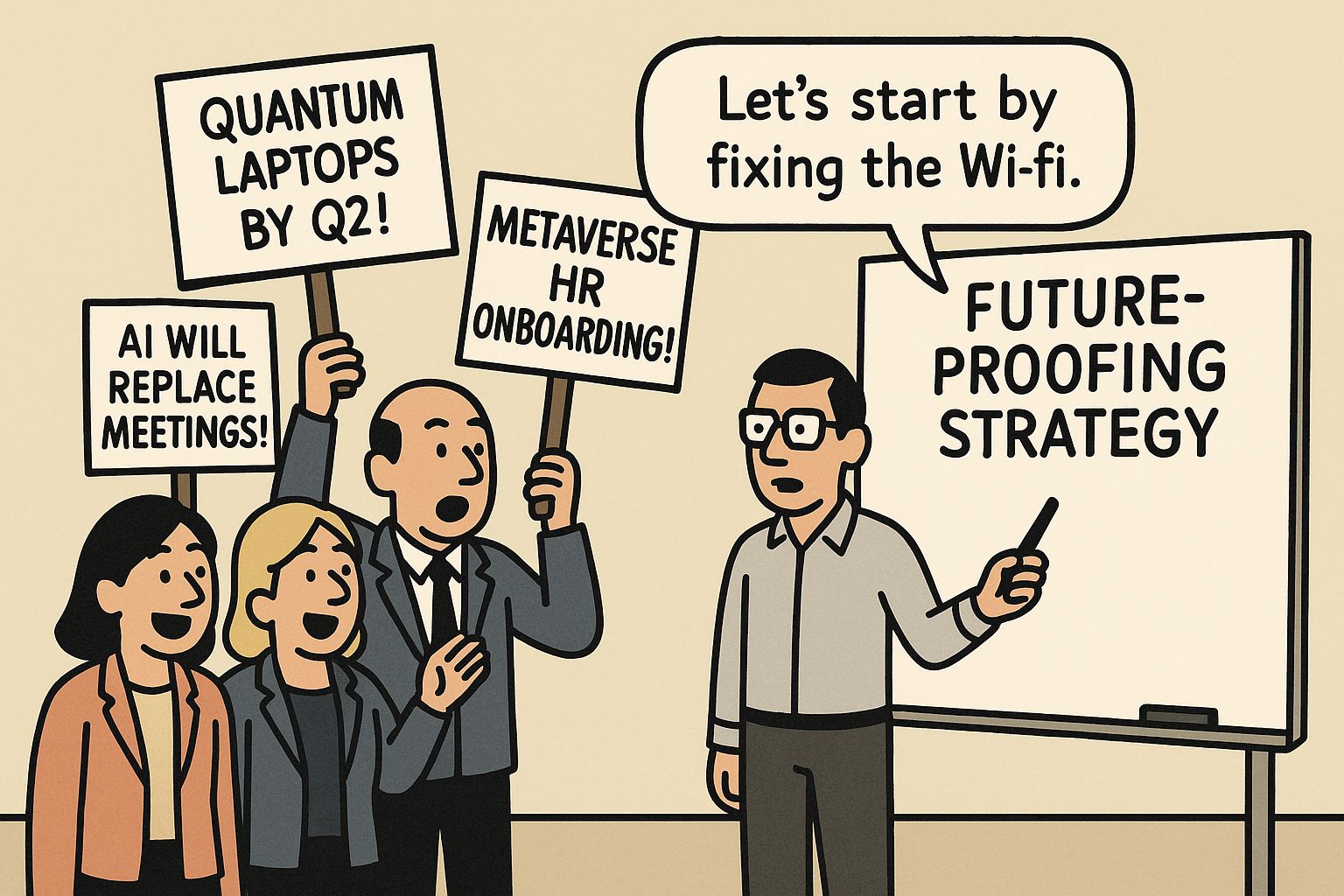
Humor in Diagrams
Reader Engagement
Quick Poll:
What’s the worst future-tech prediction you’ve survived?
VR Everywhere
Blockchain for Everything
AI Replacing Everyone
The Eternal Return of the Metaverse
Next Week’s Tease
The Enterprise Debt Collector: Managing technical and architectural debt.